
A journey into Malawi’s culinary heritage, where a humble staple food tells a remarkable story of family, generosity, identity and the enduring power of sharing a meal.
By the Culture & Lifestyle Desk
There is a particular kind of welcome that requires no grand entrance, no expensive table setting and no elaborate speech. It begins with an invitation to sit down. Someone brings a plate. A pot is lifted from the fire. Conversations unfold, children move between the adults, and the simple act of eating becomes an opportunity to belong.
In Malawi, this familiar scene often centres on nsima, the thick maize-flour staple that has long occupied a central place in the country’s culinary and social life.
For the international traveller, nsima offers more than an introduction to Malawian food. It opens a window into the country’s values, its relationship with agriculture, its family traditions and its understanding of hospitality. Recognised by UNESCO in 2017 as an element of the Intangible Cultural Heritage of Humanity, the culinary tradition of nsima demonstrates how food can carry knowledge, customs and identity across generations.
To understand Malawi through its food is to discover that some of the country’s most meaningful cultural experiences happen not in grand monuments or formal attractions, but around an ordinary family table.
More than food: a tradition rooted in everyday life

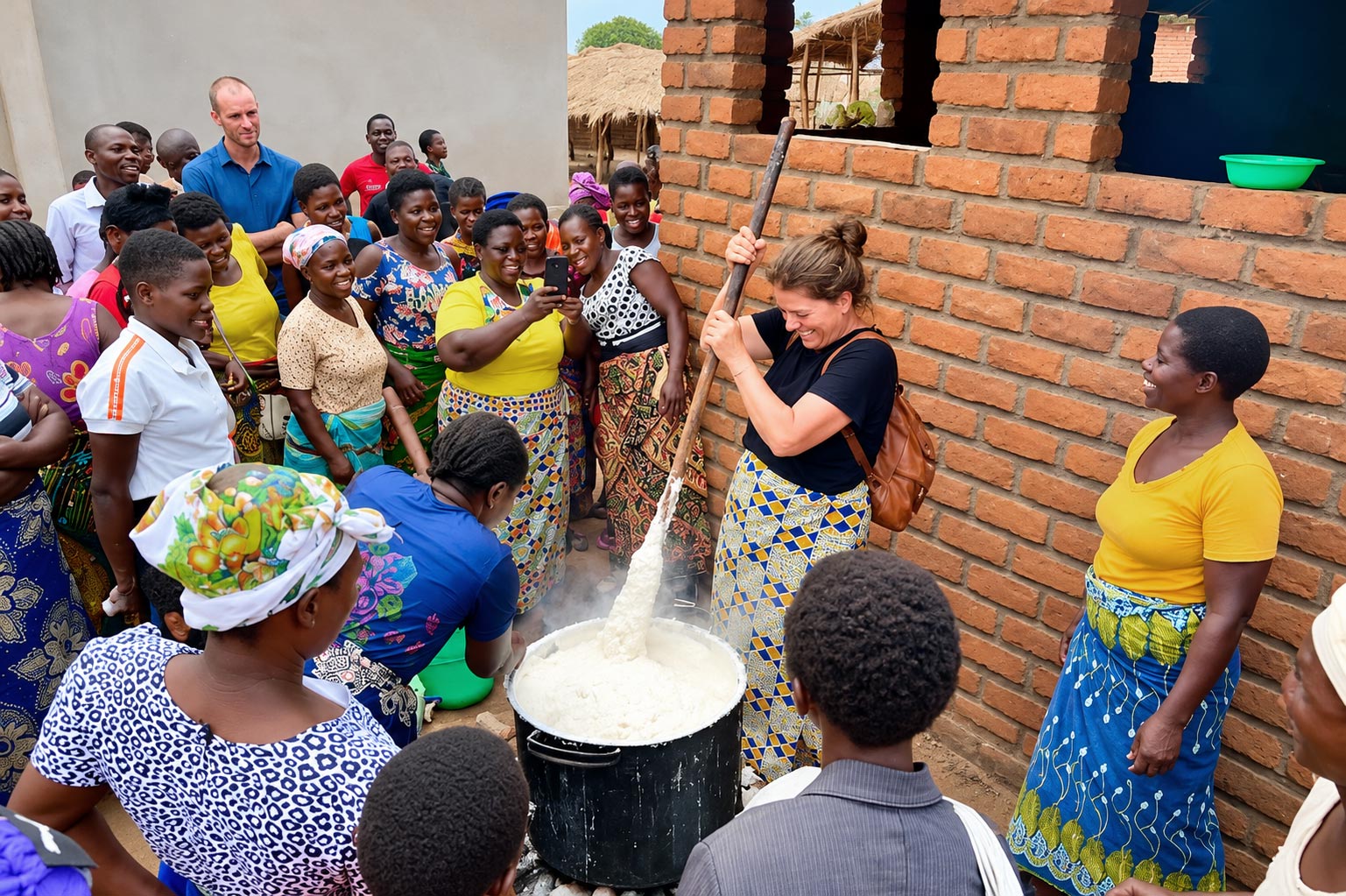
At its simplest, nsima is prepared by gradually mixing maize flour into hot water and cooking it until it forms a firm, smooth mass. It is typically served with ndiwo—the accompanying dishes, which may include leafy vegetables, beans, groundnuts, fish or meat, depending on the household, region, season and available resources.
Yet the tradition extends well beyond the recipe.
UNESCO’s documentation explains that nsima involves knowledge and practices spanning the cultivation and storage of maize, the processing of grain into flour, preparation of the meal and customs observed when eating together. The knowledge is passed from one generation to another through daily practice and participation in family life.
In this sense, nsima is both a food and a cultural process.
The maize field, the flour mill, the kitchen and the dining space form part of the same story. Each stage connects people to the land, to those who produce their food and to the knowledge inherited from earlier generations.
For visitors accustomed to restaurants where food arrives as a finished product, witnessing this process can be revealing. The preparation itself becomes part of the experience: the heat rising from the cooking pot, the steady movement of the wooden cooking stick and the careful attention required to achieve the right consistency.
What might initially appear ordinary begins to reveal its depth.
The language of hospitality
Hospitality is often described through the language of service: attentive staff, comfortable rooms, efficient transport and memorable dining. In many Malawian homes, however, welcome is also expressed through personal gestures—greetings, conversation, an offer of food and the willingness to make room for another person.
The official Malawi tourism platform identifies interaction with local people as one of the highlights of visiting the country. Village visits can provide opportunities for travellers to learn about daily life, traditions and community practices through genuine engagement rather than staged cultural displays.
The shared meal is an especially meaningful setting for such encounters.
Food creates an opportunity for people from different backgrounds to meet on familiar ground. A visitor may arrive unfamiliar with the language, the ingredients or the customs surrounding the meal, but curiosity and respectful participation can bridge much of that distance.
For the traveller, the experience is an invitation to listen as much as to taste. Who prepared the meal? Where did the ingredients come from? Which dishes are associated with celebrations? How have cooking practices changed between generations?
These questions can lead to stories about family, farming, migration, changing lifestyles and the influence of modern life on traditional food.
The most valuable cultural encounters do not turn local people into exhibits. They recognise them as hosts, experts in their own traditions and participants in a living culture that continues to evolve.
A taste of place: from the lakeshore to the highlands


One of the pleasures of exploring Malawian cuisine is discovering how the same staple can accompany different foods in different settings.
Along the shores of Lake Malawi, fish may be a prominent feature of the meal. In farming communities, seasonal vegetables, beans and groundnuts can play an important role. In urban homes, the table may bring together traditional dishes with ingredients and cooking methods influenced by modern lifestyles.
The variations are part of the attraction. There is no single plate that represents every Malawian household, and no one recipe can capture the country’s full culinary diversity.
Markets offer another perspective. They are places where visitors can observe the produce that sustains local kitchens, discover seasonal ingredients and see the close relationship between food, trade and community life. Malawi Tourism highlights market visits as an opportunity to experience the country’s everyday culture through its food, crafts and traditional dress.
For international travellers, a guided market visit followed by a cooking demonstration and shared meal could become one of the most memorable parts of a holiday.
It is an experience that combines taste, learning and human connection. It also provides opportunities for local cooks, farmers, guides and small businesses to participate directly in tourism.
The meal becomes more than something consumed. It becomes a way of understanding the destination.
Women, knowledge and the generations

Traditional food carries knowledge that is not always written down. Much of it is learned by watching, helping, practising and gradually developing an understanding of ingredients, timing and technique.
UNESCO’s account of the nsima tradition describes how preparation skills and related knowledge have historically been transmitted within families, including from older women to younger generations. It also recognises the wider community knowledge associated with obtaining and preparing accompanying foods.
A recipe may appear simple on paper, yet the practical knowledge behind it can take years to develop. Knowing when the mixture has reached the right consistency, how to prepare a particular relish or how to make the best use of seasonal ingredients involves experience that cannot always be captured in a list of instructions.
Today, urbanisation, changing work patterns, convenience foods and new cooking technologies are influencing how families prepare and eat meals. These changes do not automatically mean that tradition is disappearing. They show that culture is continually negotiated between inherited knowledge and contemporary life.
For younger Malawians, learning traditional cooking can be a way to remain connected to family history while adapting the cuisine to modern kitchens and international tastes.
For tourism businesses, involving local cooks and food producers in culinary experiences can help preserve skills while creating opportunities for income and recognition.
The goal should not be to freeze culture in the past, but to give it room to thrive in the present.
A cultural experience worth travelling for

International tourism increasingly offers opportunities to discover destinations through their food, creative traditions and everyday social life. In Malawi, the nsima tradition provides a natural foundation for experiences that are educational, welcoming and locally grounded.
Imagine an itinerary that begins with a guided walk through a local market. A host introduces visitors to maize flour, fresh vegetables and the ingredients used to prepare a family meal. In the kitchen, guests observe the cooking process, learn how different dishes are made and discover the stories behind them.
The experience ends around a shared table, where conversation becomes as important as the food.
Such a programme could be offered through a community tourism initiative, a lodge working with nearby households, or a local culinary enterprise. The specific format should be designed with participating communities, ensuring that hosts decide what they wish to share and receive fair compensation for their time, knowledge and ingredients.
Malawi’s tourism authorities already promote village visits as a way to engage with real communities and learn about local life. Responsible travel guidance also emphasises maximising benefits to local people while minimising negative social and environmental impacts.
The opportunity is to build on those foundations with carefully designed culinary experiences that meet international expectations for quality, safety, accessibility and cultural respect.
For travellers, the reward is a deeper understanding of Malawi.
For communities, the benefits can include income, recognition of traditional knowledge and opportunities for younger generations to participate in cultural tourism on their own terms.
How to experience Malawian food respectfully
For visitors who wish to explore nsima and the wider food culture, a few simple principles can make the experience more rewarding.
- Accept the invitation to learn. Ask your host to explain the dishes and their significance rather than assuming every household follows the same customs.
- Be open to new flavours. Try different relishes and ask about local ingredients, including seasonal vegetables, beans, groundnuts and fish.
- Follow your host’s lead. Customs around washing hands, serving food and eating vary between households. Observe and ask politely when unsure.
- Respect personal and cultural boundaries. Ask permission before photographing people, homes or food preparation, especially in private settings.
- Support local livelihoods. Where appropriate, book community-led experiences, purchase locally made products and pay agreed fees fairly.
A respectful visitor does not need to know every custom in advance. Genuine curiosity, consideration and a willingness to listen are an excellent beginning.
Preserving the future of a living tradition
The recognition of nsima by UNESCO places Malawi’s culinary heritage within an international conversation about safeguarding intangible cultural practices. It also highlights a wider truth: cultural heritage survives when people continue to practise it, teach it and find meaning in it.
Preservation does not rest solely with museums, official programmes or tourism operators. It happens in homes where children learn to cook, in markets where farmers sell their produce, and in communities where people continue to gather around food.
Tourism can contribute positively when it creates demand for local ingredients, recognises the expertise of cooks and producers, and gives communities a meaningful role in presenting their heritage.
It can also create challenges if traditions are simplified to satisfy visitors, cultural experiences are staged without community consent, or the people who provide the knowledge receive little of the economic benefit.
The most sustainable approach treats cultural heritage as something communities own and shape, not merely a product for outsiders to consume.
That principle matters well beyond food. It applies to music, dance, crafts, storytelling, traditional knowledge and the many expressions of identity that make Malawi distinctive.
The warmth that remains after the meal
There are many ways to remember a country. Some travellers remember the scenery, others the wildlife, the architecture or the colour of a sunset.
In Malawi, a meal can become an equally lasting memory.
It may be the taste of a relish prepared from fresh ingredients, the sound of conversation around a family table, or the moment a visitor realises that a simple staple carries generations of knowledge and meaning.
Nsima reminds us that culture is not always found in extraordinary places. Sometimes it is found in the familiar rhythms of everyday life—in growing food, preparing it, sharing it and teaching others how it is done.
For international visitors, discovering this tradition offers more than a culinary adventure. It provides an opportunity to encounter Malawi through its people, understand a little more of its values and leave with a richer appreciation of the country.
And perhaps that is the greatest promise of cultural travel: not simply to see somewhere new, but to understand something more deeply about the people who call it home.
In Malawi, the invitation may begin with a seat at the table. What follows can stay with a traveller long after the journey ends.
Leave a Reply